Welcome to Zhejiang Yulian Technology Co., Ltd. | Call Us: +86-577-62893739


Views: 0 Author: Site Editor Publish Time: 2026-08-20 Origin: Site


Modern vehicle architectures demand absolute precision across every electronic subsystem. A single component failure can trigger cascading warranty claims. It often brings expensive recalls and severe safety liabilities to the brand. OEMs and Tier 1 suppliers are rapidly transitioning from early prototyping to mass production. We must look beyond basic electrical specifications today. You must evaluate long-term reliability thoroughly. Vehicles operate under severe environmental conditions daily. High temperatures and corrosive fluids attack components constantly. Choosing the right interconnects dictates overall system success. You need a rigid evaluation framework to select components. We will explore how to meet modern power, signal, and environmental demands. This detailed guide ensures successful integration. It helps you achieve strict compliance for your specific vehicle platform.
Environmental sealing must account for high-pressure washing and fluid resistance (IP67/IP69K), not just baseline moisture protection.
Vibration resistance requires secondary locking mechanisms (CPA/TPA) to prevent micro-fretting and signal degradation.
Thermal management and current carrying capacity must be evaluated using realistic derating curves, particularly for EV/HEV applications.
True reliability requires verifiable compliance with industry standards (e.g., USCAR-2, LV214), supported by robust PPAP documentation from the manufacturer.
Connectors in engine compartments face brutal realities constantly. They endure extreme temperature cycling and harsh road salts. Automotive fluids and high-pressure washdowns batter them daily. You cannot rely on basic moisture protection alone. We must evaluate advanced environmental sealing deeply.
IP ratings often confuse procurement teams. IP67 provides a standard baseline. It protects against temporary water submersion. However, IP69K is mandatory for unshielded external zones. IP69K guarantees survival against high-pressure steam jets. It withstands high-temperature washdowns common in fleet maintenance.
Sealing technologies dictate long-term survival. You will primarily encounter matte seals and radial seals. Matte seals handle multi-wire configurations incredibly well. Radial seals offer robust single-wire protection. Be careful about material compatibility. Certain wire insulation materials react poorly to specific seal compounds. Silicone seals might swell if exposed to certain transmission fluids.
Capillary action acts as a silent killer. Temperature cycling creates a vacuum effect inside the housing. Moisture travels up the wire harness directly into the connector. Evaluate how the design blocks this specific migration path. Anti-capillary wire construction often pairs best alongside robust housing seals.
Shortlisting logic remains very straightforward. Reject components lacking certified ingress testing. Ensure they test across the full specified temperature range. A robust automotive connector must survive these extremes reliably. Uncertified components introduce unacceptable field risks.
IP Rating | Protection Level | Typical Automotive Application Zone |
|---|---|---|
IP65 | Low-pressure water jets | Interior cabin, protected dashboard zones |
IP67 | Temporary submersion (1 meter, 30 mins) | Shielded chassis components, doors |
IP69K | High-pressure, high-temp steam jets | Engine bay, underbody, wheel wells |
Engine and road vibrations cause constant micro-movements at the contact interface. These tiny shifts trigger fretting corrosion quickly. Fresh metal exposes itself to oxygen. Oxidation layers build up over the contact points. Contact resistance increases steadily over time. Eventual signal failure becomes inevitable. We must prioritize mechanical integrity always.
Secondary locking mechanisms are absolutely non-negotiable. Terminal Position Assurance (TPA) ensures terminals sit fully seated. It prevents terminal push-out during mating. Connector Position Assurance (CPA) prevents accidental unmating during harsh vehicle operation.
Contact design requires careful engineering scrutiny. Look closely at multi-point contact designs. Dual-beam or box-and-spring contacts maintain vital electrical continuity. They perform beautifully during severe shock and vibration profiles. They ensure constant pressure against the mating pin.
Watch out for implementation risks on the assembly line. Ensure CPA and TPA mechanisms provide distinct tactile feedback. Operators should feel a clear snap. They must hear an audible click during assembly. This simple feature prevents dangerous operator errors on the production line.
Verify inclusion of TPA mechanisms on all multi-way housings.
Confirm CPA mechanisms resist accidental disengagement forces.
Assess contact beam material for high fatigue resistance.
Test mating forces to ensure ergonomic manual assembly.
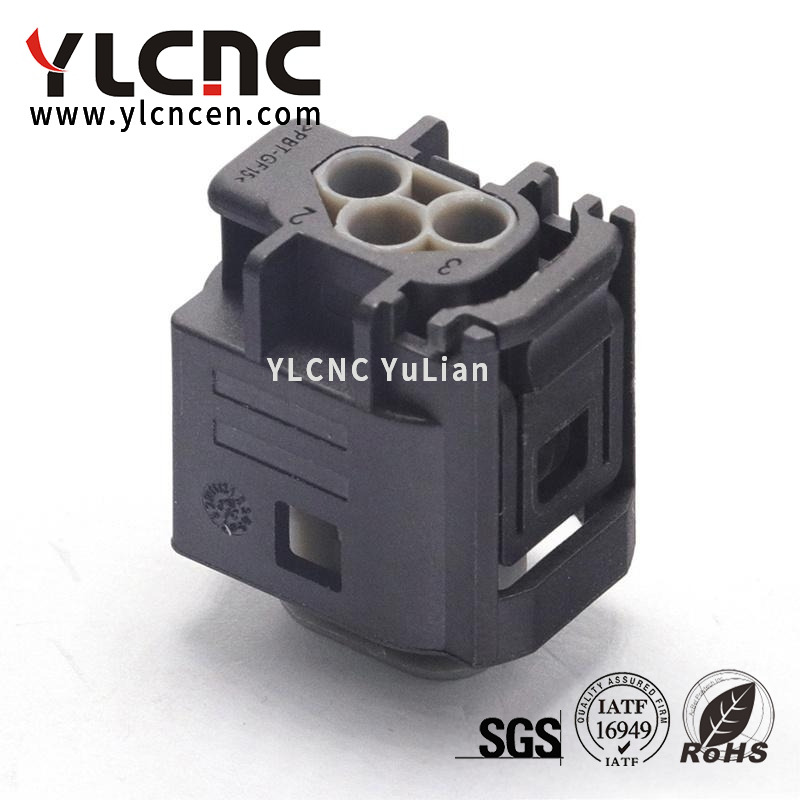
The rise of electrified powertrains demands massive power delivery. Advanced driver-assistance systems (ADAS) also draw heavy currents continuously. We must manage this power without risking thermal runaway. Heat destroys contact springs and melts plastic housings.
Reading derating curves accurately is highly critical. Engineers must evaluate current ratings at maximum ambient temperatures. You cannot rely on baseline room temperature data. Ambient heat severely limits safe power transmission. As ambient temperature rises, the connector can carry less current safely.
High-voltage applications require dedicated hardware safety features. Evaluate High-Voltage Interlock Loops (HVIL). These loops cut system power before the main pins separate. You also need touch-safe (IP2X) designs. These physical barriers protect operators and technicians during maintenance.
Material selection dictates overall thermal efficiency. Assess the use of high-conductivity copper alloys. Look for advanced plating options on the terminals. Silver or specialized tin variants manage heat dissipation excellently. Silver offers incredibly low contact resistance for high-power lines.
Trust tangible evidence over theoretical models. Request specific thermal cycling test data. Do not rely on maximum theoretical current limits. You need real-world performance metrics to guarantee safety.
Any viable connector system must align with global testing standards. We rely primarily on USCAR-2 in North America. European markets depend heavily on LV214. These standards define the rigid baseline for acceptable performance.
Testing rigor separates reliable components from weak ones. Assess compliance across mechanical testing phases carefully. Mating and unmating force must meet exact specifications. Electrical insulation resistance requires rigorous validation after exposure. Environmental thermal shock testing is equally critical for longevity.
Material compliance ensures safe and legal integration. Verify strict RoHS and REACH compliance. You also need UL94 V-0 flammability ratings where applicable. A V-0 rating means burning stops within 10 seconds. It prevents vehicle fires from spreading rapidly.
Maintain a highly skeptical lens during procurement. Do not accept casual compliance claims. Avoid products just "designed to meet" standard requirements. Require actual, signed test reports. Demand third-party validation to mitigate future compliance risks down the line.
A high-performing feature set means nothing if quality drops. The supplier must deliver consistent quality at massive volumes. Evaluating your production partner is crucial for project success.
Can the components seamlessly integrate into automated lines? We need compatibility across automated wire processing equipment. Look for specific packaging like tape and reel formats. Tape and reel feeds pick-and-place machines efficiently. Ergonomic designs speed up manual assembly stages on the harness board.
Quality documentation serves as a major filter. The right automotive connector manufacturer must provide detailed paperwork. Demand Level 3 Production Part Approval Process (PPAP) documentation. They must hold an active IATF 16949 certification. This proves their quality management system meets automotive standards.
Evaluate their global supply chain resilience carefully. Map their localized manufacturing footprint. Investigate their raw material sourcing transparency. You must mitigate component allocation risks proactively. Dual-sourcing critical resins and metals shows strong operational maturity.
Level 3 PPAP availability (including PFMEA and Control Plans).
IATF 16949 certification validity.
Automated assembly packaging options (tape and reel).
Transparent raw material supply chains.
Selecting the right connector system requires careful balancing. We balance environmental resilience against mechanical stability. Thermal efficiency and strict standard adherence complete the picture. You cannot sacrifice one metric for another. Vehicle safety depends entirely on these interconnects.
Your engineering and procurement teams must align closely. Cross-reference your operational environment matrices directly. Compare them against the supplier's verified test data. Do this before requesting physical samples for validation. This structured approach ensures long-term field reliability and system safety across your fleet.
A: USCAR-2 originates in North America, driven by the Big Three automakers. LV214 originates in Europe, driven by German manufacturers. They share similar goals but vary slightly in testing severity. LV214 generally places stricter requirements on terminal crimp resistance and severe vibration profiles.
A: TPA prevents terminal push-out. It physically locks the metal terminal inside the plastic housing. If a terminal backs out during vehicle operation, it breaks the electrical circuit. TPA acts as a secondary lock to eliminate manufacturing defects and ensure full seating.
A: Heat increases electrical resistance. As ambient temperature rises, the connector cannot dissipate internal heat as efficiently. Engineers use thermal derating curves to calculate this. You must lower the safe power transmission limit as the surrounding temperature gets hotter.
A: Look for Level 3 PPAP submissions. Key elements include Process Flow Diagrams, Process Failure Mode and Effects Analysis (PFMEA), and robust Control Plans. You should also verify dimensional results and material test reports to ensure consistent mass production quality.


